How to Get Gold in Sandustry
Every way Gold is produced, what a pile of sand is actually worth, and why the Gold on your floor is not money until it sits in a Collector.
GamePrimer EditorialUpdated Verified
Drop Water on Sand to make Wet Sand, drop that on a Shaker, and one in four pixels comes out as Gold. Then put a Collector under where the Gold lands — Gold sitting anywhere else is not money and cannot be spent.
Gold is one of the two materials the whole game runs on, the other being Fluxite. Every research unlock is priced in it, and it turns up as a byproduct of nearly every processing line you build.
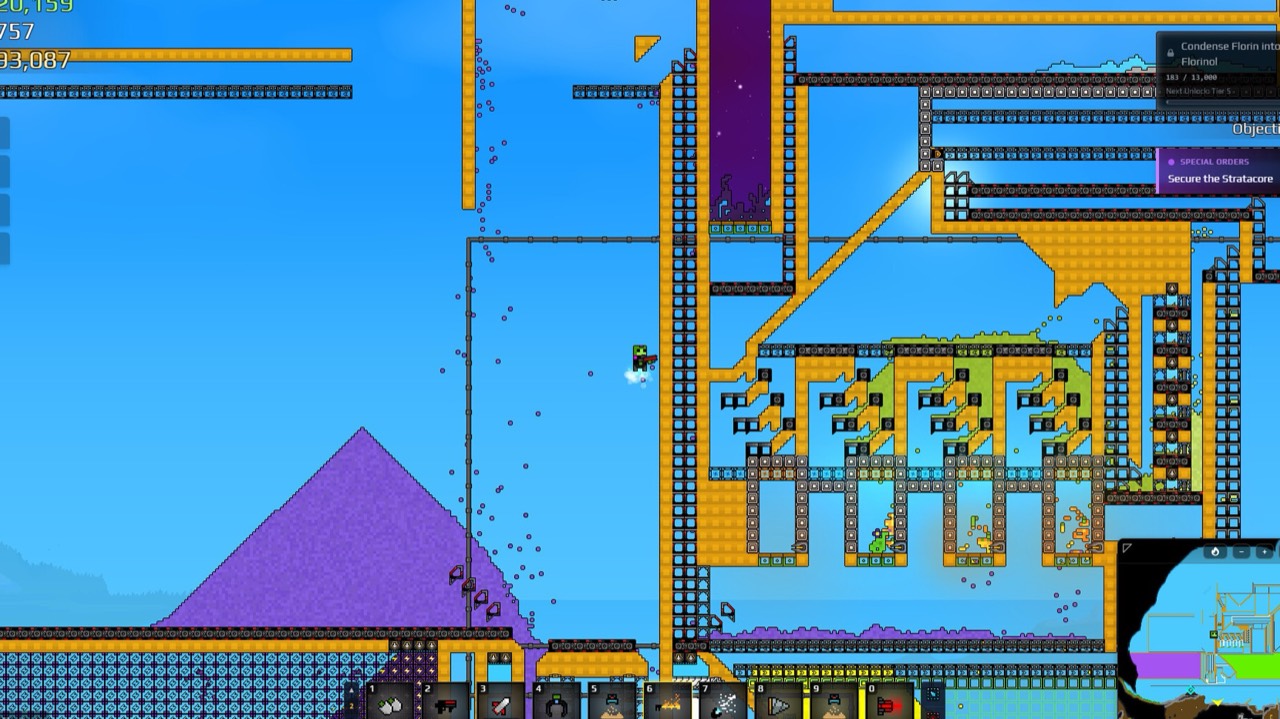
The Collector, first
This is the part that costs new players an hour. Gold lying on the ground is inventory, not currency. It only counts towards the number in your HUD, and only becomes spendable, while it is sitting inside a Collector tile.
Collectors are not solid. Pixels fall straight through them, so a Collector on its own is a hole your Gold falls past. Put a solid Block underneath, or drop the Collector into a pit, so the Gold has somewhere to come to rest inside it.
Your first Gold, with nothing researched
You need Sand, Water and a Shaker. The Shaker is the cheapest unlock in the game at 20 Gold — and you start with enough to buy it.
- Find loose Sand and pour Water onto it. Each Sand pixel that a Water pixel touches becomes two Wet Sand.
- Drop the Wet Sand onto a Shaker from above. No belt is needed for this; falling is enough.
- Every Wet Sand pixel produces one Residue. One in four also produces a Gold.
That is the entire loop, and it funds everything else.
What a pile of Sand is actually worth
How much Gold you get out of Sand depends entirely on how far you take it. There are three honest answers, not one:
| How far you process | Gold you get |
|---|---|
| Shaker only | 1 Gold per 2 Sand |
| Also burning the Residue and pressing it | 1 Gold per 1 Sand |
| Full chain, including planting the Seeds | 3 Gold per 2 Sand |
The full chain works out at Official2 Sand = 3 Gold, which is what the wiki quotes. The other two rows are the same chain stopped early.
Those are averages over volume. Two of the steps are dice rolls — the Shaker’s Gold and the Residue’s burn both succeed a quarter of the time — so a handful of pixels tells you nothing and a running line tells you everything.
Every source of Gold
The Shaker. One in four Wet Sand pixels. This is your baseline and it never stops being worth running.
The Kinetic Press. Burnt Residue dropped from at least 25 blocks up becomes 1 Gold and 1 Seed, every time — no dice roll at this step. Getting the Residue burnt is the lossy part, not the pressing. Full walkthrough on the slag processing page.
Flowers. Seeds from the Press, wet with Water and dropped on a Planter Box, grow into a Flower. Destroy the Flower and it drops 4 Amethelis and 1 Gold. The Planter Box passes exactly two solids through itself — Gold and Amethelis — so the harvest falls out the bottom and everything else stays put.
Getting Gold out of a mixed line
Gold has a density of 300, the heaviest pixel in the game. In any mixed pile it is already at the bottom, which is exactly where a Filter picks up.
So the reliable move is a Filter set to Allow Gold: the Gold drops through and is deposited below, and everything lighter rides over the top like a normal Conveyor Belt. Pull the densest material out first and each following separation gets easier. The filters page covers why the reverse order fails.
When Gold starts taking up space
Late lines produce Gold faster than you spend it, and a heap of Gold pixels is a heap of simulated pixels.
The Smelter (tier 5, 3,000 Gold) melts Gold into Liquid Gold, which takes far less room and still counts as currency as long as it is in a Collector. It is the answer when your bank is physically in the way.
Related
- Sandustry Beginner Guide — where this loop fits in your first hour
- Sandustry Production Chains — every step of the chain, with sources
- Sandustry Research Planner — what all this Gold is going to buy
